Introduction
Hidden deep within the arid cliffs on the west bank of Luxor lies one of the world’s most mysterious and awe-inspiring archaeological sites: The Valley of the Kings.
It is far more than a burial ground — it is an open-air museum that tells the story of eternity as the ancient Egyptians envisioned it.
Beneath the rocky hills rest the greatest pharaohs of Egypt, surrounded by sacred texts and vivid wall paintings that narrate their journey to the afterlife.
1. Historical Background
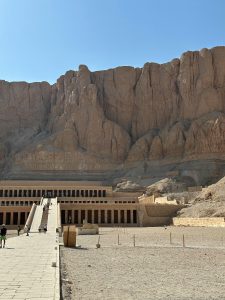
The Valley of the Kings became Egypt’s royal necropolis at the beginning of the New Kingdom (around 1550 BCE), when pharaohs abandoned the idea of building visible pyramids and sought hidden tombs carved deep into the desert mountains to protect their treasures from tomb robbers.
The first king to be buried here was Thutmose I, followed by generations of rulers from the 18th to the 20th dynasties, including Thutmose III, Amenhotep III, Ramses II, Ramses III, and the legendary Tutankhamun.
In total, archaeologists have discovered over 60 royal tombs, though new discoveries still emerge from time to time, proving that the valley has not yet revealed all its secrets.
2. Architecture and Decoration
The tombs of the Valley of the Kings represent some of the finest achievements of ancient Egyptian art and architecture.
Each tomb was meticulously carved into the limestone hills, consisting of long corridors, chambers, and burial halls, all decorated with colorful hieroglyphic inscriptions and religious texts such as the Book of the Dead and the Book of Gates.
These paintings depict gods, spirits, and mythical scenes that guided the pharaoh’s soul through the underworld toward eternal life in the “Fields of Iaru,” the Egyptian paradise.
Among the most remarkable tombs are the Tomb of Seti I (KV17), renowned for its intricate and beautifully preserved wall paintings, and the Tomb of Tutankhamun (KV62), whose treasures of gold, alabaster, and precious stones remain some of the most iconic artifacts in human history.
3. Archaeological Discoveries
Exploration of the valley began in the 19th century, but the most groundbreaking discovery occurred in 1922, when British archaeologist Howard Carter uncovered the nearly intact tomb of King Tutankhamun.
This find became the greatest archaeological discovery of the 20th century, containing more than 5,000 artifacts — from furniture and statues to jewelry and the legendary golden funerary mask, now a universal symbol of ancient Egypt’s splendor.
4. Cultural and Historical Significance
The Valley of the Kings reflects the ancient Egyptians’ deep belief in immortality and rebirth.
These tombs were not simply graves; they were gateways to eternity, designed to ensure the king’s safe passage to the afterlife.
The valley also stands as undeniable evidence of the engineering genius and artistic mastery of ancient Egyptian builders, who managed to create complex underground structures using the simplest of tools.
Today, the site is recognized as a UNESCO World Heritage Site and attracts thousands of visitors each year who come to walk the same paths once tread by kings and priests over 3,000 years ago.
Conclusion
The Valley of the Kings remains a symbol of mystery, grandeur, and eternal life.
Every tomb, every hieroglyph, and every faded color tells a story of divine kingship and humanity’s timeless pursuit of immortality.
Visiting the valley is not merely a journey through ancient tunnels — it is a journey through time itself, inviting us to stand face-to-face with the pharaohs and the undying spirit of one of the greatest civilizations ever known.